Over the past decade, 'gamification' has become one of the most misused buzzwords in modern technology. App designers throw spinning wheels, confetti animations, cartoon badges, and arbitrary coin systems at everything from banking portals to language tutorials.
The result is often exhausting. Instead of making you genuinely productive, bad gamification treats you like a lab rat being conditioned with superficial bells and whistles. You find yourself spending twenty minutes tweaking virtual avatars or collecting digital stickers rather than actually reading, running, or working.
Because of this, many thoughtful people have rejected gamification entirely, retreating to blank paper notebooks and stoic, spartan discipline.
This is throwing the baby out with the bathwater. Games are not compelling because of confetti animations; they are compelling because they provide pristine clarity of intent, immediate confirmation of effort, and unmistakable evidence of gradual mastery.
The secret to gamifying your life lies in restraint: applying high-leverage game mechanics strictly to provide clarity and feedback, without letting the system devour your reality.
The Great Gamification Misunderstanding
The fundamental flaw of mainstream gamification is the assumption that the goal is to make every single human activity 'fun' or 'entertaining.'
Deep, meaningful work is not always fun. Doing heavy deadlifts at 7:00 AM burns. Debugging memory leaks in production code is tedious. Reviewing financial statements after a long week is mentally taxing. Pretending these activities are a bright, cheerful playground game is childish and dishonest.
The purpose of game mechanics is not to mask the difficulty of real-world labor. It is to provide structural clarity, eliminate ambiguity, and offer a transparent scorekeeping mechanism for accumulated effort.
The Mechanics That Actually Work
When designing a personal progression architecture, only seven core game mechanics consistently deliver long-term behavioral benefits:
1. Clear, Unambiguous Objectives
In a game, you never encounter an objective that says: 'Maybe try to be somewhat healthy today.' You are given an exact target: 'Cross the bridge and locate the outpost.' Real-life quests must be equally bounded.
2. Immediate Sensory Feedback
Actions must have instantaneous closure. The act of checking off a quest and witnessing an XP bar increment anchors the reward to the physical behavior.
3. Cumulative Progress Bars
Humans are visually wired to appreciate completion. Watching an incomplete ring close or a level gauge approach 100% harnesses our natural psychological drive for closure.
4. Tiered Milestone Thresholds
Levels break decades of effort into digestible chapters. Advancing from Level 3 to Level 4 gives you a mid-term milestone to celebrate while the ten-year vision unfolds.
5. Time-Bounded Challenges
Short sprints—such as a 7-day streak or a 30-minute deep work duel against Distraction—concentrate focus and elevate arousal to optimal performance levels.
6. Continuity Streaks
Streaks create skin in the game. Once you possess a 14-day chain, your desire to preserve the streak overrides the momentary impulse to take the evening off.
Where Gamification Becomes Destructive
Gamification becomes toxic the moment point-collection replaces actual judgment. Common failure modes include:
1. Neurotic Over-Tracking
If you assign points to drinking a glass of water, brushing your teeth, petting your dog, and breathing in the morning, your system will collapse under administrative overhead. Track only high-leverage behaviors that require intentional activation energy.
2. Goodhart's Law & Cheating
When a measure becomes a target, it ceases to be a good measure. If you give yourself points for 'reading', you may catch yourself scanning pages mindlessly just to log the XP. You are the only person being cheated.
The 6-Step Practical Implementation Method
To set up an effective, grounded gamification system without unnecessary noise, execute this six-step sequence:
Select One High-Priority Growth Domain
Choose a single pillar to fortify first: Physical Strength, Deep Work Focus, or Daily Knowledge. Resisting the urge to gamify everything at once guarantees high execution quality.
Define 1-3 Measurable, Binary Actions
Strip away subjective ambiguity. Use binary, observable behaviors: 'Complete 25 pushups', 'Read 10 pages', or 'Write 300 words'.
Package the Actions as Explicit Quests
Give each action a clear initiation cue and a defined reward value in XP. Framing the task as an active quest sharpens focus.
Log Completion Immediately at Point of Action
Never defer logging to the end of the day when memory fades. Record the completion within 60 seconds of physical execution to seal the neural reward loop.
Inspect Visible Progress Indicators
Take two seconds to observe your progress ring close, your XP bar rise, or your streak counter advance. Absorb the reality of the completed repetition.
Conduct a 5-Minute Weekly Review
Every Sunday evening, inspect your total XP harvested across the week. Calibrate quest difficulty upwards only if execution was flawless.
A Mature, High-Contrast Quest Engine
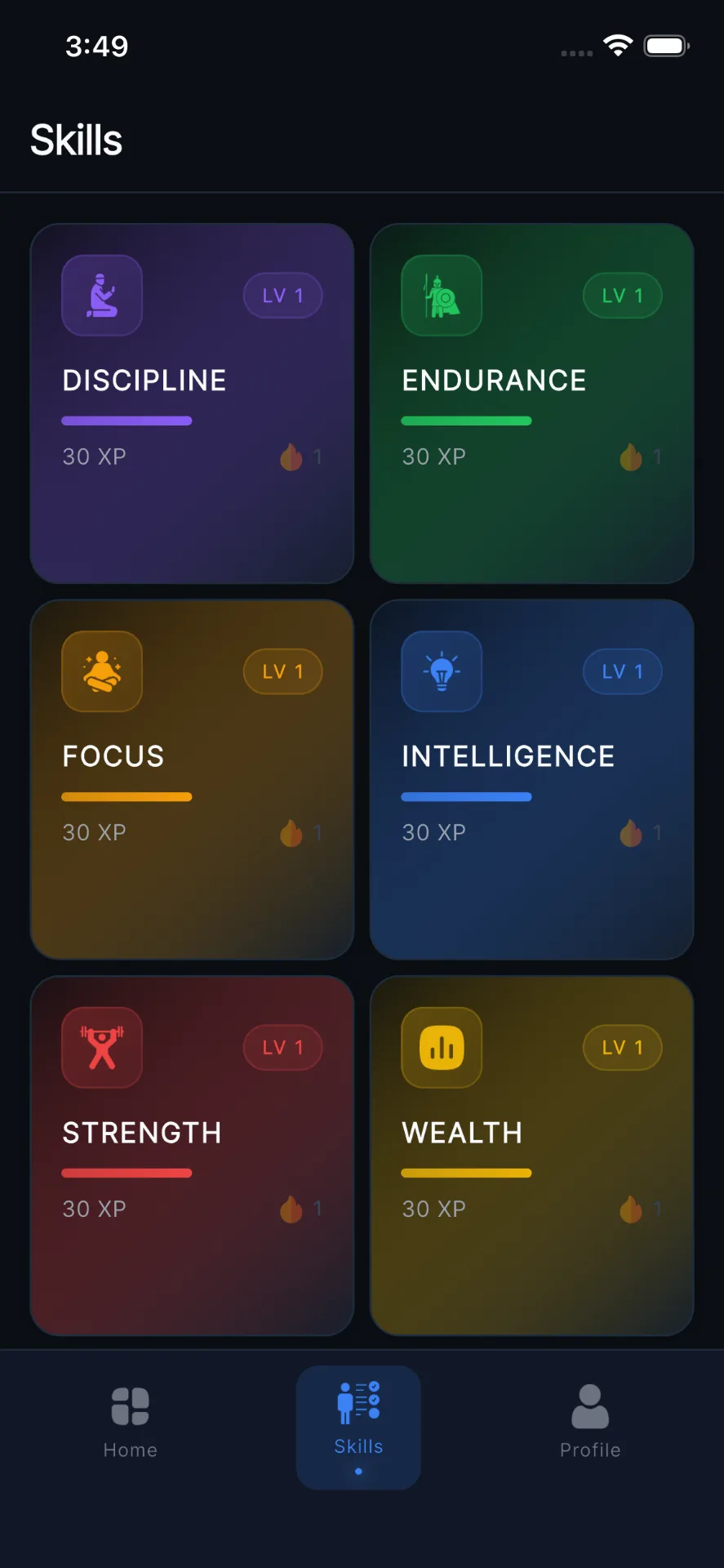
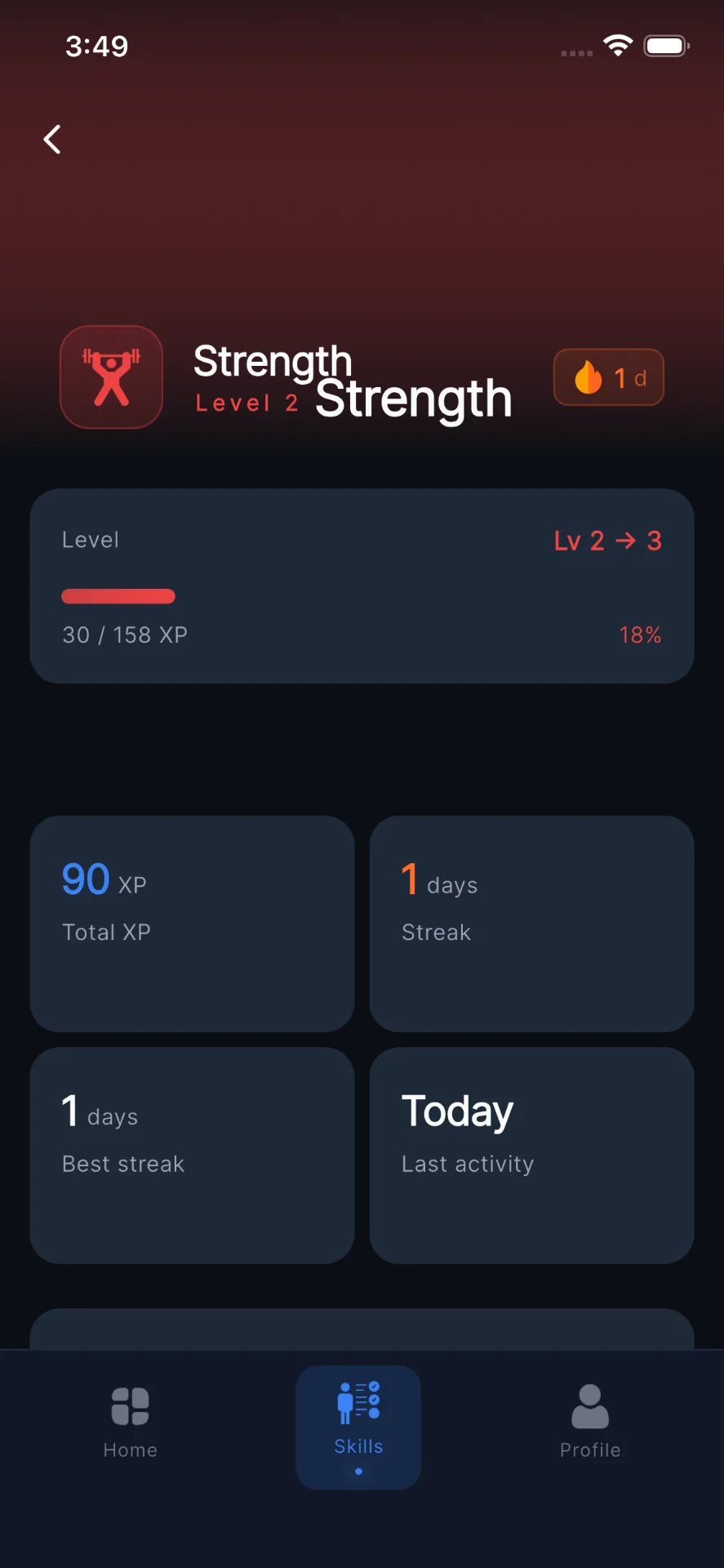
Ascend was engineered from the ground up to solve the gamification paradox: providing high-potency visual feedback without the childish clutter.
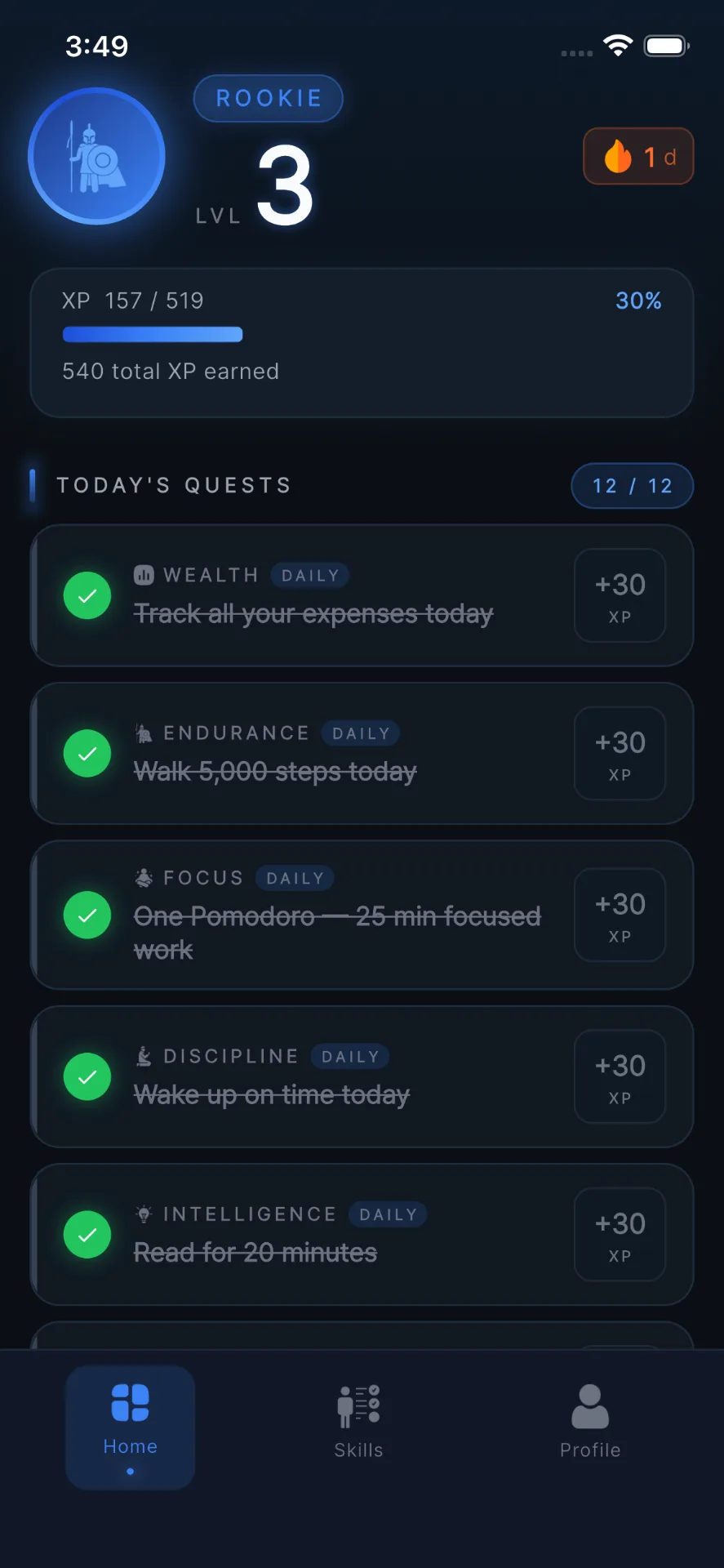
In Ascend, quests are crisp, dark, and elegant. You set daily habits and recurring objectives that reward calibrated XP directly into your core pillars. There are no cheesy animations or distracting mini-games—only sleek titanium borders, gold progress gauges, and real-time level analytics.
The app acts as a quiet mirror of your daily discipline, ensuring you stay focused on the real-world work while enjoying the psychological benefits of visible, cumulative progression.
Final Thoughts
You do not need an imaginary kingdom to experience the thrill of character advancement. You have a real body, a real mind, real skills to cultivate, and real mountains to climb.
Use gamification as a precision scalpel, not a chaotic sledgehammer. Define your quests, measure your inputs, celebrate the XP earned today, and let the compounding mechanics do the heavy lifting.
Make your progress visible with Ascend.
Experience gamification designed for adults. No pastel cartoon gimmicks—just a dark, cinematic Life RPG that makes consistency irresistible.