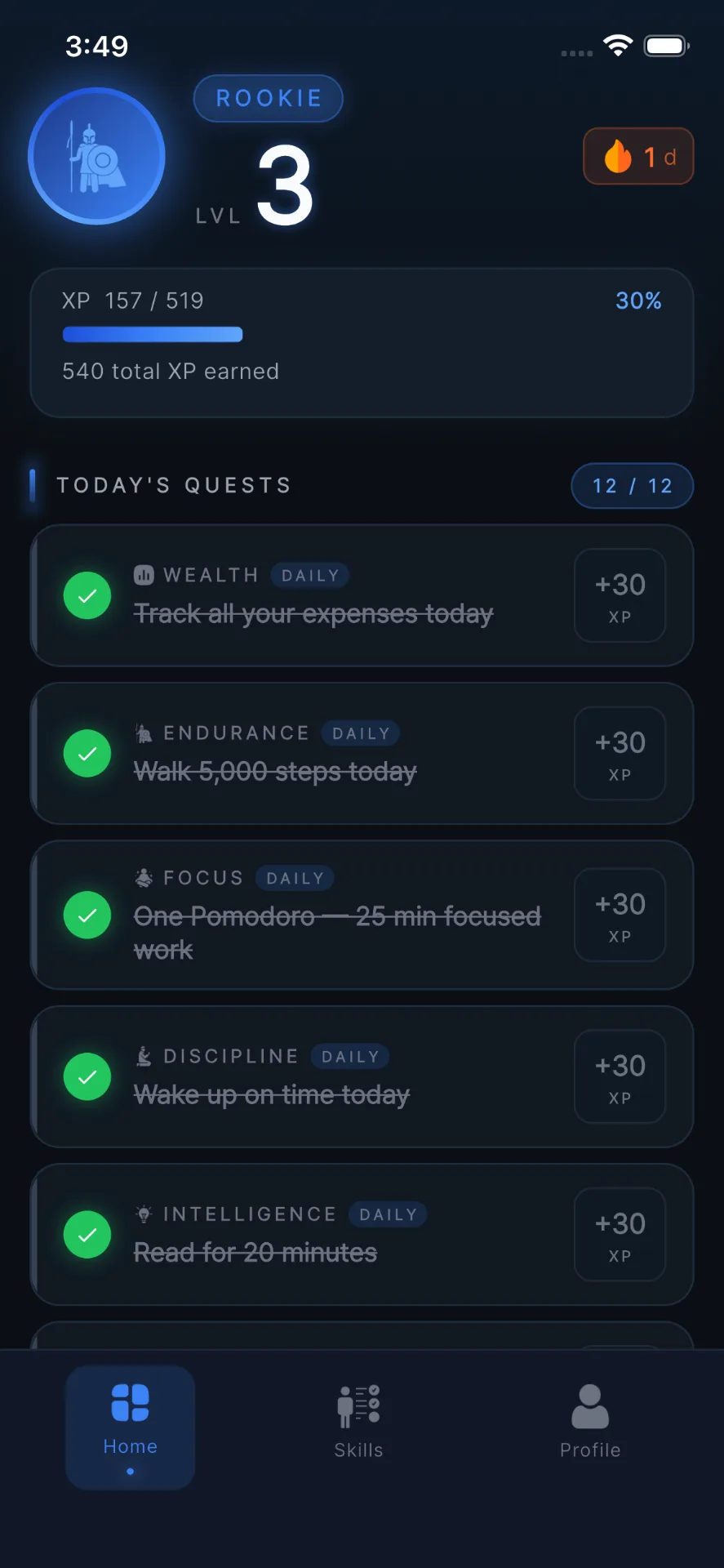
Consider the average video game enthusiast. This same person might spend five consecutive hours in an open-world RPG methodically grinding low-level tasks: gathering digital herbs, running repetitive errands for non-player characters, carefully allocating skill points into an agility tree, and studying enemy attack patterns until late at night.
Yet when Monday morning arrives, that exact same individual struggles to spend thirty minutes reviewing an online course, walking around the block, or balancing their monthly budget.
Why? Did their brain fundamentally change between Sunday night and Monday morning? Did their capacity for focus and sustained effort suddenly evaporate?
Of course not. What changed was the feedback environment.
In the video game, every second of effort is acknowledged. You know your current level, you have a clear quest log, your XP bar moves visibly with every strike, and you understand the exact mathematical payoff of upgrading a skill. In modern real life, feedback is ambiguous, delayed, noisy, and often demoralizing.
This is where the Life RPG concept enters. A Life RPG takes the behavioral clarity, objective structure, and visual progression of role-playing games and maps them onto your real, physical existence. It does not replace the work; it fixes the broken feedback loop.
What Is a Life RPG?
At its core, a Life RPG is a cognitive lens that reframes personal development as character progression. Instead of viewing yourself as a static, flawed person burdened by an endless list of uninspiring adult chores, you view yourself as an evolving protagonist operating in an open-world sandbox.
Your body and mind are your avatar. Your daily responsibilities are quests. The bad habits holding you back are debuffs or dungeon bosses. And the consistent actions you take day after day are the grind that earns Experience Points (XP) to unlock higher tiers of personal capability.
It is crucial to clarify what a Life RPG is not. It is not escapism. You are not pretending to be an elf throwing fireballs in a virtual tavern. A true Life RPG is grounded firmly in the physical world: the sweat on your brow during a squat, the lines of code you debug, the book you annotate, and the financial discipline you maintain.
Mapping RPG Mechanics to Reality
To understand how a Life RPG operates in practice, look at how the fundamental mechanics of gaming translate directly into human personal development:
Character = You (The Player & The Avatar)
In a game, you never get furious at a Level 1 character for failing to wield a legendary sword. You understand they simply have not accumulated the requisite stat requirements yet. When you view yourself as a developing character, self-criticism transforms into tactical patience.
Stats = Areas of Personal Mastery
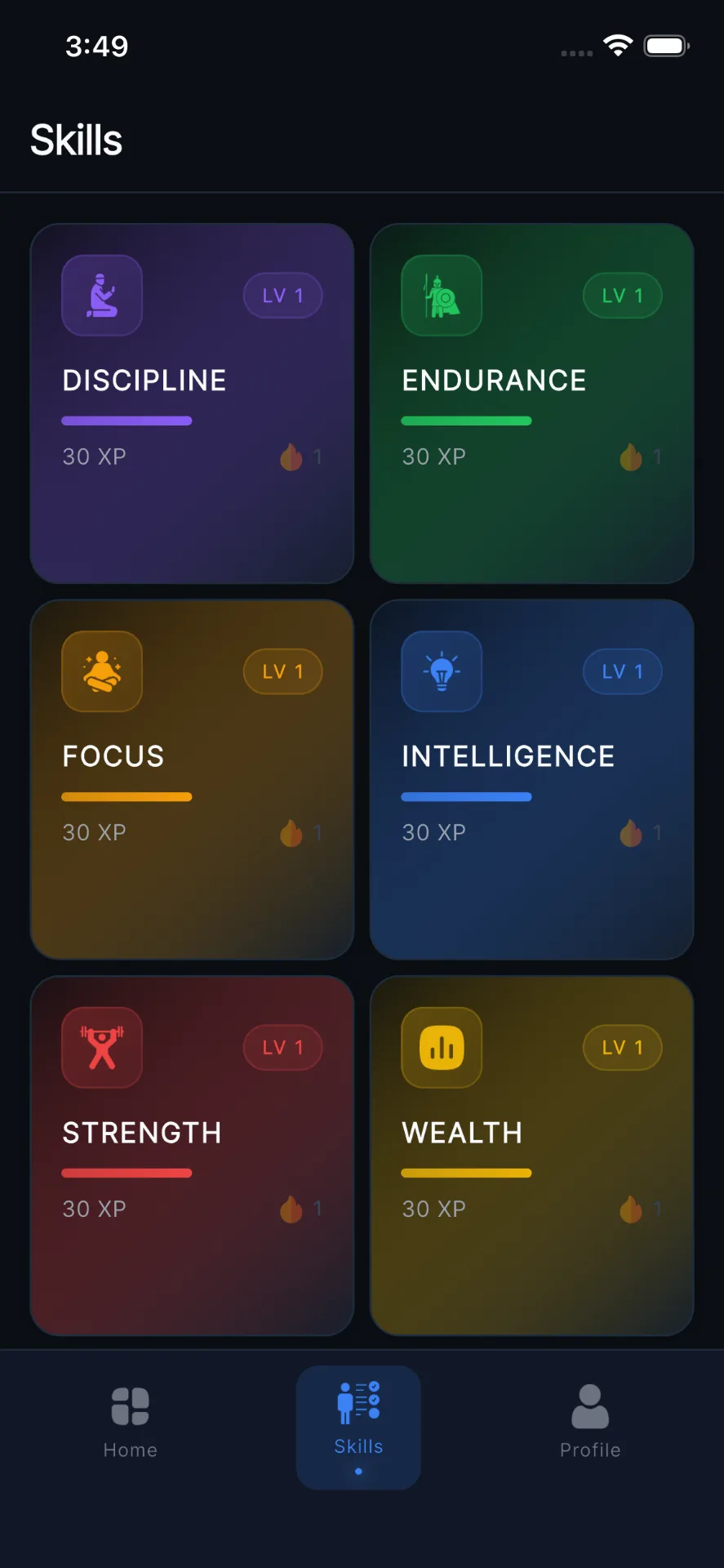
Just as a paladin balances armor and faith, or a rogue balances speed and stealth, your real life consists of distinct attributes. Physical health is Strength and Endurance; mental prowess is Intelligence and Focus; emotional resilience is Discipline; financial foundation is Wealth.
Quests = Discrete Daily Actions
Vague to-do items ('be productive today') are replaced with explicit, bounded quests ('Read 15 pages', 'Log 5km run', 'Review budget ledger'). Quests have clear initiation conditions and definitive completion states.
XP = Completed Behavioral Inputs
Experience Points serve as a universal currency of effort. Every time you push through resistance and finish a quest, you harvest XP that increments your total lifetime progression score.
Levels = Real-World Competence Milestones
Levels represent accumulated threshold shifts. Reaching Level 10 in Strength means your physical baseline has fundamentally altered compared to when you started at Level 1.
The Psychology of Tangible Feedback
Why does this metaphor have such profound psychological utility? It comes down to cognitive reframing and dopamine economics.
When an action feels like a mundane chore ('I have to fold laundry' or 'I have to study for an exam'), your brain processes it through the lens of executive obligation, which triggers friction and procrastination.
When that exact same behavior is framed as a quest that grants tangible XP toward a visible stat bar, your brain categorizes it as an investment in character growth. You shift from a mindset of compliance ('Someone else expects me to do this') to a mindset of agency ('I am upgrading my own stats').
Facing Real-World Bosses
In traditional games, bosses are titanic monsters blocking your path to the next realm. In real life, the bosses that threaten your future are insidious behavioral patterns that drain your time, vitality, and potential.
A Life RPG names these enemies explicitly:
Sloth: The Boss of Inertia
The heavy, lethargic voice that whispers to stay in bed, skip the gym, and cancel commitments. You defeat Sloth not with sudden rage, but with small, mechanical actions that break physical inertia.
Distraction: The Boss of Fractured Attention
The infinite-scroll algorithm designed by thousands of engineers to fragment your focus. You defeat Distraction by entering protected deep work chambers and building high Focus stats.
Ignorance: The Boss of Cognitive Stagnation
The assumption that you already know enough. You defeat Ignorance through daily reading, deep intellectual curiosity, and deliberate skill acquisition.
The Limits of Gamification: Avoiding Vanity Metrics
It is vital to address the dark side of gamification: metric obsession. If you are not careful, it is easy to become obsessed with farming points for their own sake—checking off silly, trivial tasks just to watch an arbitrary number go up.
Gamification is a scaffolding, not the monument. The numbers, levels, and badges exist solely to keep your eyes on the physical reality of your growth. If an app makes you feel busy while your actual real-world skills, health, and relationships remain stagnant, the system has failed.
Ascend: Real Life Built as a Dark Fantasy RPG
Ascend was created specifically to embody the Life RPG philosophy without the childish gimmicks, pastel graphics, or superficial streaks that plague generic productivity tools.
In Ascend, you step into a dark, cinematic realm. Your profile features an RPG avatar, a radar chart mapping your Six Core Pillars (Strength, Intelligence, Discipline, Focus, Endurance, Wealth), and an active quest log.
You engage in legendary Boss Fights against Sloth, Distraction, and Ignorance. As you complete your real-life routines, you earn XP, unlock prestigious Character Classes (Warrior, Scholar, Monk, Spartan, Visionary), and climb through ranks from Rookie to Ascended.
Final Thoughts
Your life is already a game. You are already investing your daily hours into leveling up something—whether it is your career, your physical health, or your knowledge of fictional characters on a streaming platform.
The only question is: are you consciously playing the game you actually want to win?
Reframe your daily grind. View your challenges as boss encounters, your habits as daily quests, and your accumulated effort as hard-earned XP. Step into the arena, pick up your controller, and start ascending.
Turn everyday actions into quests, XP, stats and visible progress.
Stop tracking habits on boring spreadsheets. Step into Ascend and turn your daily routines into a cinematic, empowering progression system.