Look at the to-do list sitting on your desk or digital notes app right now. Chances are, it contains items that look like this: 'Work on marketing strategy,' 'Write research paper,' 'Fix app architecture,' or 'Organize finances.'
Notice how your stomach tightens slightly when you read those phrases. Notice the subtle wave of cognitive friction that prompts you to open a new browser tab, check your phone, or suddenly decide that right now is the urgent time to wipe down your kitchen counters.
For decades, popular culture has labeled this behavior as pure laziness. Self-help gurus tell you to 'just push through' or 'eat the frog.'
Yet neurobiology tells a completely different story. Procrastination is an emotional regulation problem, not a time management deficit. Your amygdala perceives large, ambiguous, undefined tasks as an existential threat: they imply the risk of failure, cognitive overwhelm, and exhaustion.
The secret to dissolving procrastination permanently is not more willpower. It is radical task decomposition—taking massive, intimidating monoliths and slicing them down into microscopic, zero-friction quests.
The Neurological Anatomy of Procrastination
When you look at a task like 'Write master thesis,' your prefrontal cortex tries to compute the hundreds of hours of research, formatting, literature review, and drafting required. The cognitive load spikes instantly.
Your limbic system steps in to protect you from that perceived discomfort by directing your attention toward immediate, high-certainty rewards: checking social media, watching a quick video, or sorting emails.
To bypass the brain's threat-detection radar, you must make the immediate next physical action so small that your amygdala registers zero perceived threat.
The Ambiguity Tax: Why Vague Tasks Paralyze You
Compare how your nervous system responds to these two contrasting task definitions:
Vague Intention vs. Decomposed Sequence
'Work on my new software project.'
1. Create the user database model schema. 2. Write the authentication token validation function. 3. Implement the email input field on the login view. 4. Test incorrect password failure error message.
The Quest Ladder Decomposition Method
To transform any terrifying objective into an actionable sequence, use the Quest Ladder framework. The Quest Ladder breaks work down into four progressive levels of altitude:
The 4 Altitude Tiers
Level 1: Large Objective — The high-level multi-month destination (e.g., 'Launch mobile application').
Level 2: Mission — A specific milestone chapter achievable in 1-2 weeks (e.g., 'Build working authentication system').
Level 3: Quest — A discrete, focused work block of 25-60 minutes (e.g., 'Implement user login UI and submit form').
Level 4: Small Action — A microscopic, 2-minute initiation sequence that requires zero willpower (e.g., 'Open login-form.tsx and import Button component').
Six Real-World Domain Decompositions
Notice how the Quest Ladder functions across every domain of real-world productivity:
1. Studying & Academics
Overwhelming: 'Study organic chemistry.'
Small Quests: 'Review lecture 4 slides on reaction mechanisms' → 'Draw five reaction pathways on a scratch sheet' → 'Complete three practice exam problems.'
2. Software Engineering
Overwhelming: 'Build search functionality.'
Small Quests: 'Define API query parameters' → 'Write the SQL index for search fields' → 'Implement search input debounce hook' → 'Render results list.'
3. Writing & Content Creation
Overwhelming: 'Write 3,000-word blog post.'
Small Quests: 'Draft 5 bullet-point section headers' → 'Write 150-word introduction hook' → 'Flesh out Section 1 examples' → 'Proofread formatting.'
4. Physical Fitness
Overwhelming: 'Get in peak marathon shape.'
Small Quests: 'Lace running sneakers' → 'Step out the front door' → 'Run 15 minutes at easy conversation pace.'
5. Home Organization
Overwhelming: 'Clean the entire apartment.'
Small Quests: 'Clear all coffee mugs from desk' → 'Put dirty laundry into hamper' → 'Wipe down kitchen island' → 'Take out trash bag.'
6. Personal & Side Projects
Overwhelming: 'Launch online consulting business.'
Small Quests: 'Draft one-paragraph service offer' → 'Create simple landing page header' → 'Send message to three previous colleagues.'
The Feedback Physics of Small Completions
Every time you check off a completed action—no matter how small—your brain releases a modest pulse of dopamine. Dopamine is not simply a pleasure molecule; it is a motivational propellant. It signals to your nervous system: 'Effort was exerted, an outcome was achieved, this was successful.'
By breaking a 4-hour project into eight 30-minute quests, you generate eight distinct motivational feedback loops rather than enduring a four-hour desert of uncertain labor.
Momentum is built through frequency of completion, not magnitude of effort.
Slicing Giant Goals Into Bite-Sized Quests in Ascend
Ascend's quest engine was engineered specifically to kill the overwhelm of vague to-do lists.
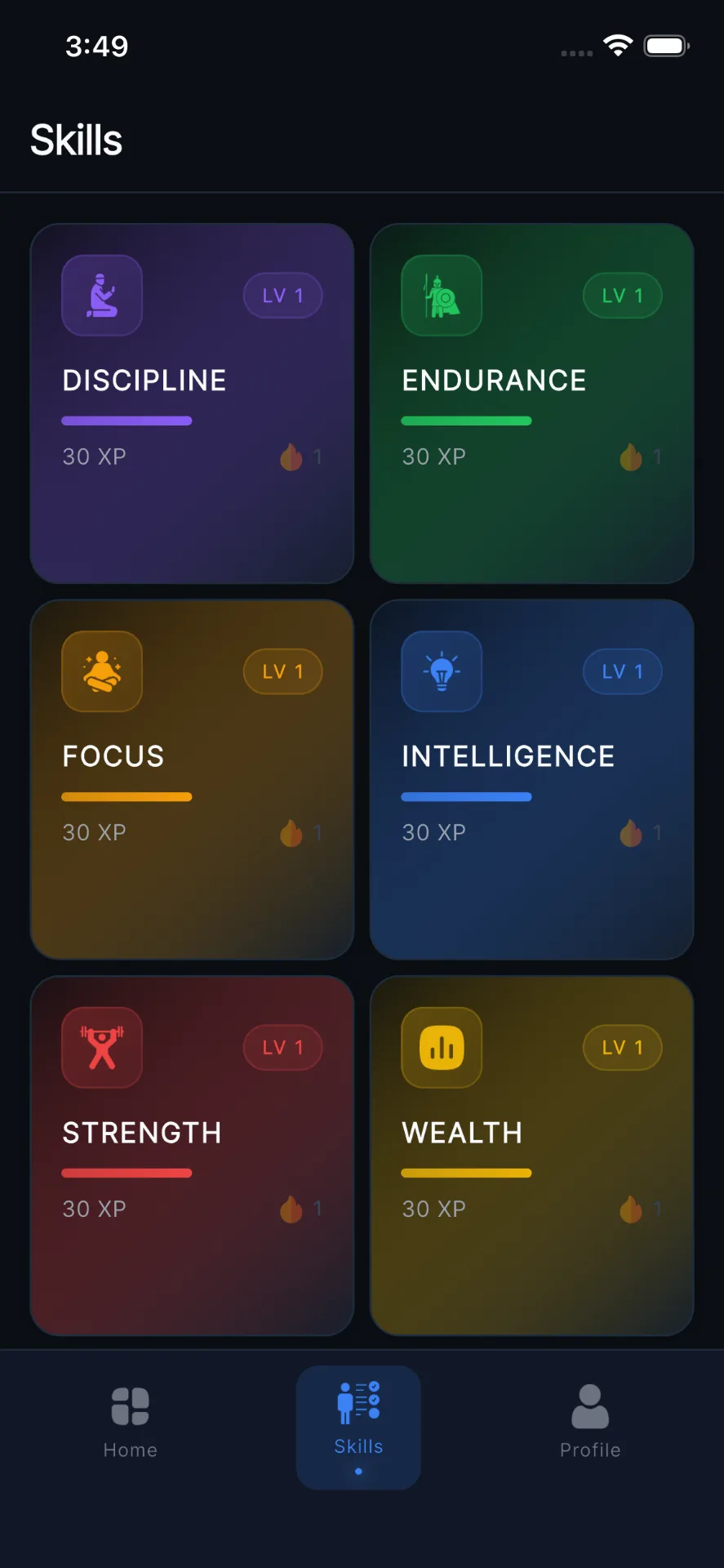
Instead of an intimidating wall of unstructured text, Ascend organizes your commitments into prioritized daily quests, each tied to a specific pillar (Strength, Intelligence, Focus, Discipline, Endurance, Wealth) and calibrated with clear XP rewards.
You see exactly what needs to be conquered today. As you complete each quest, you defeat the Boss of Distraction in real time and harvest hard-earned XP to level up your character.

Final Thoughts
You are not lazy, broken, or deficient in character. You were simply asking your brain to swallow boulders instead of pebbles.
Next time you feel the icy grip of procrastination, stop trying to summon heroic willpower. Take a breath, pull out the Quest Ladder, and cut the task down until the first step feels almost laughably simple.
Take that one tiny step. The rest of the mountain will follow.
Your next level starts with one small action.
Break free from procrastination. Use Ascend to decompose your ambitious goals into daily quests and turn execution into an exciting progression game.