Much of modern productivity advice is written as though every hour of your life should feel like a montage in an inspirational sports movie. We are told to 'find our passion,' 'enter flow states,' and 'love the process.'
This is fine when you are designing a creative masterpiece or strategizing a visionary project. But what happens when you have to reconcile forty corporate expense receipts?
What happens when you need to vacuum the stairs, format spreadsheets, organize file backups, prepare meal containers, or study hundreds of dry legal statutes? There is no secret Zen path to make categorizing utility invoices thrilling. It is inherently, irredeemably boring.
The mistake is assuming that a task must become emotionally 'fun' before you can execute it efficiently. The goal is not to turn tedious chores into an amusement park. The goal is to alter the architecture of the task so that it stops draining your cognitive reserves and starts fueling your daily momentum.
The Inescapable Reality of Tedium
Boredom is an evolutionary signal. When your brain is subjected to repetitive, low-stimulation tasks with zero immediate stakes, dopamine levels plummet. Your nervous system interprets the lack of novelty as a cue to look elsewhere for stimulation: checking your phone, grazing in the pantry, or day-dreaming.
Fighting this drop in dopamine through sheer clenched-jaw willpower is a terrible strategy. You might force yourself through thirty minutes of tedious spreadsheets, but you will emerge cognitively exhausted for the rest of the day.
Instead of fighting human biology, you must introduce structural constraints that artificially inject the three missing elements of engagement: urgency, boundaries, and confirmation.
Seven Structural Upgrades for Tedious Work
Whenever you face a task you dread, layer on these seven structural upgrades before beginning:
1. Explicit Completion Conditions
Never start with a vague boundary like 'work on taxes.' Define the exact finish line: 'All January invoices matched to bank statements.' When the brain sees a finish line, it can calculate the finish cost.
2. Aggressive Timeboxing (The Sprint Duel)
Set a physical countdown timer for 15 or 25 minutes. Challenge yourself to execute as much as possible before the buzzer rings. Parkinson's Law states that work expands to fill the time allotted; compress the time, and boredom transforms into focus.
3. Visible Progress Tally
Use physical tokens or a visual tracker. If you have 30 cold outreach emails to send, move 30 paperclips from one bowl to another. Giving physical substance to intangible progress resets the dopamine counter.
4. Sensory Pairing (Temptation Bundling)
Allow yourself to listen to an incredible podcast, an audiobook, or a specific synthwave soundtrack only while performing the boring chore (folding laundry, cleaning dishes, or treadmill cardio).
5. Continuity Streaks
Link the tedious task to a streak. When you realize that clearing your desk this evening preserves an 18-day cleanliness streak, the micro-inconvenience is outweighed by the pride of continuity.
6. Immediate Post-Task Reward
Schedule a tiny, high-quality reward the second the task concludes: an espresso, five minutes in the sun, or a favorite snack. The brain catalogs the boring task as the gatekeeper to pleasure.
7. Direct XP Conversion
Recognize that every piece of admin work completed is an investment in your Discipline or Wealth stat. You are not just cleaning a room; you are training your avatar's environmental mastery.
The Boring-to-Quest Conversion Playbook
Here is an exact breakdown of how to take an amorphous, boring chore and convert it into a crisp quest sequence:
The Room Cleaning Transformation
'I really need to spend this Saturday afternoon cleaning up my messy bedroom.'
Quest 1: Desk Surface Purge (Remove all dishes & trash) [5 min / +10 XP] Quest 2: Wardrobe Reset (Hang jackets & drop laundry into basket) [7 min / +15 XP] Quest 3: Floor Sweep & Vacuum (Run vacuum across high-traffic carpet) [8 min / +20 XP]
Momentum Physics: Lowering Activation Energy
In physical mechanics, kinetic friction (the resistance between objects already moving) is always lower than static friction (the resistance required to get an object moving from a dead stop).
The hardest moment of any boring task is the first 90 seconds. Once you touch the first dish, type the first cell in the spreadsheet, or pick up the first shirt from the floor, static friction breaks.
By structuring the initial quest to be impossibly small, you bypass the wall of boredom and ride the wave of kinetic momentum to completion.
Turning Routine Grind Into Tangible XP Rewards
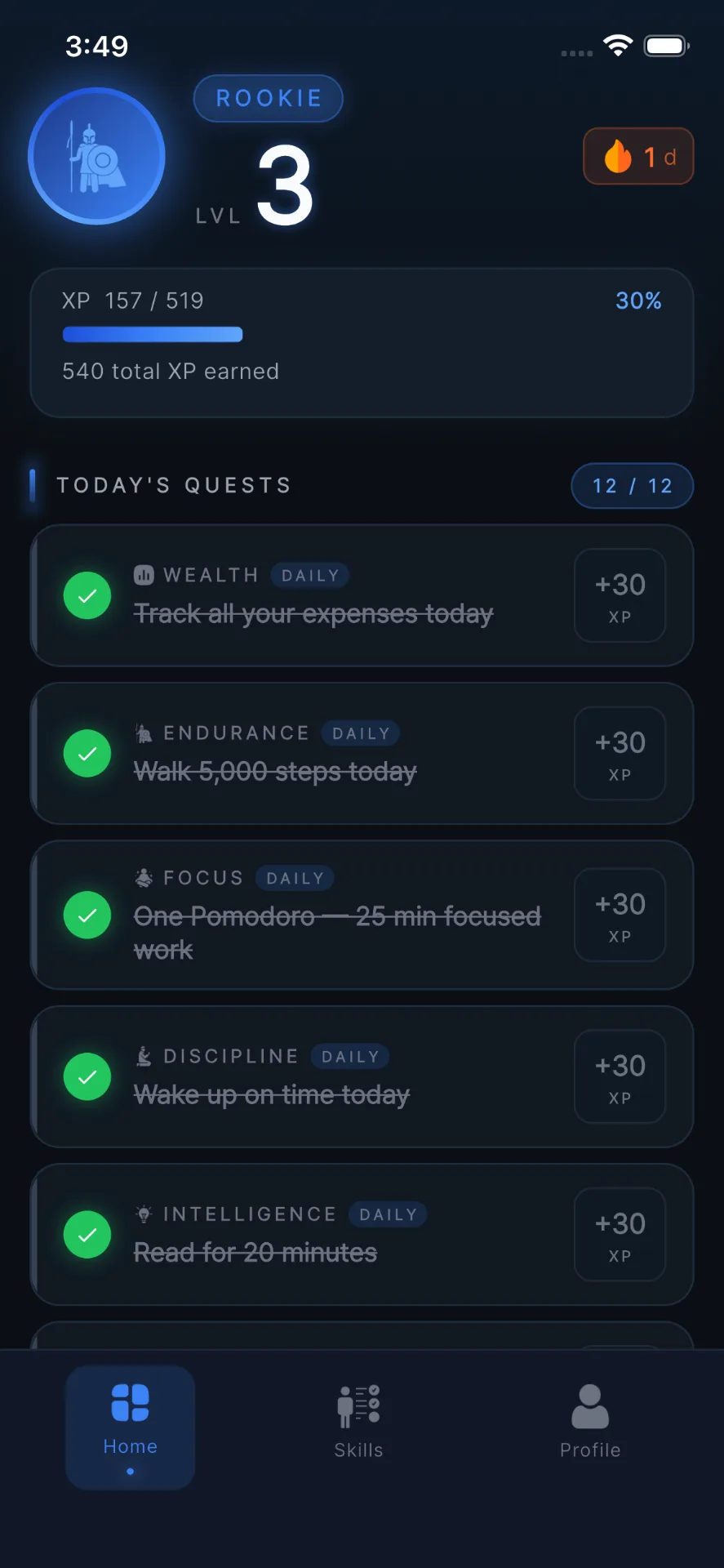
In Ascend, routine maintenance tasks are treated with the respect they deserve. Adult life requires a baseline of discipline, and Ascend makes sure that discipline never goes unrewarded.
When you finish your morning routines, clean your workspace, or log an admin session, you hit complete and watch the gold XP reward chime onto your screen. Your Discipline and Focus stats receive immediate equity.
By transforming necessary adult maintenance into character stat investments, the dread of boring chores evaporates.

Final Thoughts
You will never eliminate tedious tasks from your life. The higher you climb in your career and creative pursuits, the more administration and discipline will be demanded of you.
Stop waiting to feel motivated to do the dishes, reconcile your books, or clean your desk. Convert them into crisp, bounded quests with hard timers and immediate rewards.
Conquer the small, boring tasks with speed and grace, and preserve your creative fire for the work that transforms your world.
Ready to turn your everyday routines into a progression system?
Stop dreading chores and admin. Ascend turns daily maintenance into rewarding quests that build real character stats and unbreakable consistency.